News Update

GM Promises To Make More Vehicles That Get 40 MPG By 2017

Eight General Motors models will get 40 mpg or higher by 2017, according to a GM press release regarding the 2012 Sustainability Report. The company plans on doubling the amount of vehicles that receive those ratings by 2017 along with other objectives including increasing the number of electrified vehicles out on the road and decreasing the amount of carbon dioxide emissions from its vehicles.
Dan Akerson, chairman and CEO of General Motors, says, “Our long-term approach to sustainability enables us to increase efficiency and reimagine personal mobility to best meet customer needs and lifestyles.”
The Detroit News reports that, “Automakers are under increasing pressure to meet U.S. corporate average fuel economy fleet standards of 35.5 mpg by model year 2016, and 54.5 mpg by model year 2025.”
Right now, the Chevrolet Cruze Eco, Cruze Clean Turbo Diesel, Sonic and Volt achieve 40 mpg or higher. Edmunds notes that “the soon-to-launch 2014 Spark EV and the upcoming Cadillac ELR also will handily top that benchmark freeway figure.”
Another objective in GM's 2012 Sustainability Report is to increase the amount of GM electrified vehicles in the United States. GM told The Detroit News that in 2012 it sold 179,801 vehicles powered somewhat by electricity and 48,108 in 2011.
In their press release, General Motors says it plans to “put 500,000 vehicles on the road in the U.S. with some form of electrification by 2017.” GM vehicles that currently have some form of electrification are the Chevrolet Volt, Chevrolet Spark EV, Buick LaCrosse with eAssist, Buick Regal with eAssist, Chevrolet Malibu with eAssist and Chevrolet Impala with eAssist.
By 2016, the company would like to reduce CO2 emissions in their U.S. vehicles by 15 percent. GM says “[It] bases its sustainability priorities on an assessment of the most pressing global economic, environmental and social issues facing the company’s customers and the communities where GM does business.” GM added that key stakeholders, internal and external, believed fuel efficiency, electrification and reducing CO2 emissions are some of the top areas of improvement for General Motors.

The Best New Car Deals in July

The 2013 Honda Accord can be leased for $280 a month for three years with $0 down. (American Honda Motor Co.)
Even though the big Fourth of July car sales events are over, there are still plenty of great car deals that can help you save money this month. If you plan on financing your new car, we found many interest-free offers, low interest rates and thousands of dollars in cash back rebates. If you’d rather lease your new car, there are many options, including lease deals that don’t require a down payment and leases with low monthly payments when you make a down payment. New car sales were strong in June, and automakers are trying to keep the sales momentum going with these incentives.
Lease Deals
If you’d rather not make a down payment when you lease a new car, there are quite a few $0 down lease deals available this July. Keep in mind that these lease offers generally have higher monthly payments. No money down leases can be found at Honda, Acura and Mazda dealerships this month. The 2013 Honda Accord is available for $280 a month for three years, and the 2013 CR-V can be leased for $300 a month, also for three years. The three-row 2013 Mazda CX-9 is available this July for $319 a month for three years in many areas of the country, and the 2014 Mazda6 has a three-year lease for $269 a month in most areas. Acura, Honda’s luxury brand, is offering the new 2014 RLX for $600 a month for three years, and the 2013 MDX for $500 a month for three years.
Check out July lease offers from Nissan, Kia, Volkswagen, Jeep, Dodge, Chrysler, Toyota, Chevrolet, Ford, Hyundai, Mitsubishi, Scion and Subaru if you want a lease deal with low monthly payments. These brands have lease offers with payments ranging from about $100 to $300 a month when you put several thousand dollars down. For example, the 2013 Chevrolet Cruze can be leased for $149 a month for three years with $2,129 due at signing. The 2013 Volkswagen Passat is available for $199 a month for three years with a $2,349 down payment. The 2013 Hyundai Elantra can be leased for $159 a month for three years with $2,199 due at signing.
Purchase Deals
Take a look at the car deals from Toyota, Chevrolet, GMC, Buick and Mazda if you’re looking to finance your new vehicle with a low- or no-interest car loan, or are searching for cash rebates. The 2013 GMC Terrain can be purchased with zero percent financing for four years this July. The 2013 Chevrolet Volt has $4,000 in cash incentives right now, and the 2013 Impala is available with either zero percent financing for six years or $4,000 cash back. Truck shoppers can save money on the 2013 Toyota Tundra by taking advantage of zero percent financing combined with $500 to $1,000 financing cash, or $2,750 cash.

Car Thieves Love the Ford F-250

If you own a Cadillac Escalade, you can breathe a little easier. After years of being the vehicle with the most insurance theft claims, the luxury large SUV is no longer the preferred target of car thieves. According to the Highway Loss Data Institute, the Ford F-250 is now the vehicle most likely to be involved in car insurance theft claims. In fact, the HLDI reports that the F-250 has theft claims at a rate that's six times the average rate for all vehicles.
The Ford F-250 (Ford Motor Company)
Large pickup trucks and SUVs are still the favorite targets of car thieves, but the HLDI reports that, overall, the rate of vehicle thefts is declining. The institute credits ignition immobilizers, which are standard on 89 percent of 2012 model-year vehicles, for the drop. "Fewer pickups than cars or SUVs have the feature as standard, which may help explain the higher theft rates for pickups," says the HLDI.
The HLDI compiles its list of most-stolen vehicles from insurance claims on vehicles from the past three model years and notes, "Many pickup claims result from the theft of equipment from the truck bed, and that may be the case with some of the F-250 claims. HLDI's data don't distinguish theft of vehicle contents or components from theft of a whole vehicle."
According to the HLDI, vehicles with the highest insurance theft claims include the Chevrolet Silverado, Chevrolet Avalanche, GMC Sierra and Ford F-350. Vehicles with the lowest claims include the Dodge Journey, Volkswagen Tiguan, Audi A4 and Acura RDX.
To prevent vehicle theft, it's always a good idea to park in a well-lit, highly visible area. If your car didn't come standard with an ignition immobilizer, which prevents thieves from hot-wiring a car, you can have one installed. When you leave your car, make sure valuables are secured out of sight. If you drive a pickup, a lockable tool box, tonneau cover or bed cap can keep your gear safer.

Study: Women Are Better At Negotiating Auto Repair Costs Than Men


(Toyota Motor Sales, U.S.A., Inc.)
A study conducted by Kellogg School of Management at Northwestern University and AutoMD.com, an auto repair website, shows women who don’t seem to know average repair costs will pay more for their vehicle to get serviced than males. However, the study also finds that repair shops are more likely to negotiate with women.
For the study, researchers got male and female volunteers to call auto repair shops to receive quotes on how much it would cost to replace the radiator in a 2003 Toyota Camry. When calling, the volunteers stated that they knew the average price for the repair ($365), said that they expected to pay an inflated price ($510), or stated that they were clueless as to what the repair may cost.
In the end, men who didn’t know the average price of the repair or who said the average price is $365 received the same quote. Those men and women who didn’t have any idea what to the repair should cost were quoted higher prices. Women who knew the average rate were quoted prices similar to what men were quoted, but they received higher quotes than men if they stated the higher price or said they didn't know what the repair should cost.
When both genders tried to negotiate, most auto repair shops weren’t willing to change their prices. However, the researchers found that women were able to negotiate 35 percent of the time, while men were only able to negotiate 25 percent of the time.
The study suggests that you should do your research before getting quotes from auto repair shops. In addition, women should make sure they appear knowledge able about what the repair should cost. For men, researchers said it’s a little easier to get a better price, but they added that men should not hint that they aren’t knowledgeable about repair costs.
You can find the average price for various car repairs in your area by clicking the "Repairs" tab from any of our car reviews.  We have reviews of most cars going back to 2007, so finding repair costs for your car should be easy.

More Than 650,000 Chrysler Vehicles Recalled


2013 Chrysler 200 (Chrysler Group)
In two separate press releases on Wednesday, Chrysler Group announced that they will be recalling more than 650,000 vehicles in the U.S.
Chrysler Group says one recall affects about 442,000 of the following U.S. models: 2011-2013 Chrysler Sebring, Chrysler 200, Dodge Avenger, Jeep Liberty and 2011-2012 Dodge Nitro. The problem, according to Chrysler, is possible “faulty microcontrollers” that could negatively impact the performance of active head restraints during a crash. Active head restraints are designed to help protect passengers from neck injuries when the vehicle is struck from behind.
Chrysler adds that the microcontrollers “entered the supply chain after the 2011 earthquake and tsunami in Japan caused a worldwide microcontroller shortage.” The supplier of this part has not been identified.
For those vehicles affected, Chrysler will notify their owners and Chrysler dealerships will replace the microcontroller or upgrade the software free of charge.
The second recall affects 224,000 2013 Dodge Grand Caravan, Chrysler Town & Country and Ram Cargo Van models, and is due to a software problem that deploys side airbags on the unaffected side of the vehicle in a side impact.
Chrysler says that after receiving a customer complaint, they investigated the problem and found that, in a collision, the airbag from the side of the car opposite the collision deploys. Only the side affected by the crash is supposed to be deployed. Chrysler adds that the airbags in the steering wheel and dashboard are not affected.
Chrysler will update the airbag-control software to correct this problem.
Owners of vehicles with either of these recalls can call Chrysler Group at 1-800-853-1403 for more information.

Diesel Vehicles are Less Expensive to Own

2013 Volkswagen Golf TDI (Volkswagen of America)
Although they often cost more up front, a new study indicates that diesel-powered cars, trucks and SUVs have lower ownership costs in the long run. In a press release, dieselforum.org says that diesel models cost $2,000 to $6,000 less to own over three to five years than comparable gas-powered vehicles. The study was conducted by the University of Michigan Transportation Research Institute for Robert Bosch LLC, which makes automotive parts for diesel- and gasoline-powered vehicles.
Diesel cars typically earn better fuel economy ratings than their gas-powered counterparts, but other variables are also at play when it comes to lower ownership costs. Autoblog writes, “The savings stem not just from improved fuel efficiency but also overall fuel costs and better retention of value, and take into account the added purchase price of a diesel engine over its gasoline counterpart.
The study finds that diesel-powered versions of small cars like the Volkswagen Golf and Jetta save their owners $5,013 and $3,128, respectively over the course of three years. Additionally, the Volkswagen Jetta SportWagen costs $3,389 less to own when equipped with a diesel engine.
The savings also translate to luxury cars and SUVs. Diesel versions of the Mercedes-Benz E-Class and M-Class save their owners $4,175 and $3,063, respectively, while the diesel-powered Mercedes R-Class costs $5,951 less to own. The diesel-powered Volkswagen Touareg and Mercedes GL-Class offer even bigger savings, with ownership costs that are $7,819 and $13,514 lower, in that order.
Some automotive journalists think that lower ownership costs will bolster consumer demand for diesel vehicles. The Los Angeles Times reports that the diesel-powered Volkswagen Jetta is “the third-most-considered vehicle by people shopping for alternative-fuel cars,” according to analysts at Edmunds.

Ford F-150 is Most American-Made Vehicle

(Ford Motor Company)
The Ford F-150 took the top spot away from the four-year champ, the Toyota Camry, on Cars.com’s 2013 American-Made Index. Cars.com ranks models by analyzing the percent of domestic parts used in the vehicle, where the final assembly of the vehicle takes place and the vehicle’s sales numbers.
Patrick Olsen, editor-in-chief at Cars.com, says in a statement that this isn’t the first time the F-150 has topped the list, as it was first place from 2006 to 2008 before losing out to the Camry, which took second place this year. He adds, “Ford’s top ranking this year is a good indicator of how pickup trucks are dominating auto sales so far in 2013, and how the domestic automakers are bouncing back. While the assembly point and domestic parts content of the F-150 didn’t change from 2012-2013, vehicle sales are responsible for bumping the F-150 to the top spot.”
Bloomberg says that the F-Series is experiencing the largest growth in U.S. sales so far this year. Sales through the end of May are up 22 percent from last year.
The F-150 has 75 percent of its parts made in the U.S., according to the National Highway Traffic Safety Administration. Overall, there are only 14 vehicles on NHTSA’s 2013 American Automobile Labeling Act Report that are assembled in the U.S. and have at least 75 percent of their parts made in the U.S. or Canada compared to 20 in 2012.
Even though the F-150 beat out the Camry this year, Toyota still has more vehicles on Cars.com’s list than any other automaker. The Toyota Sienna ranks fifth, the Toyota Tundra is seventh and the Toyota Avalon is 10th.
2013 Rank
Make/Model
Rank in 2012
1.
Ford F-150
2
2.
Toyota Camry
1
3.
Dodge Avenger
N/A
4.
Honda Odyssey
N/A
5.
Toyota Sienna
4
6.
Chevrolet Traverse
6
7.
Toyota Tundra
7
8.
GMC Acadia
9
9.
Buick Enclave
10
10.
Toyota Avalon
N/A
Olsen notes that purchasing an American-made vehicle isn’t a priority for every vehicle buyer out there, but he says it’s important for consumers to know that buying an American-made vehicle isn’t limited to buying only a Ford, Chrysler Group or General Motors vehicle.

Federal Government Delays Rule for Mandatory Back-Up Camera in New Vehicles

(General Motors)
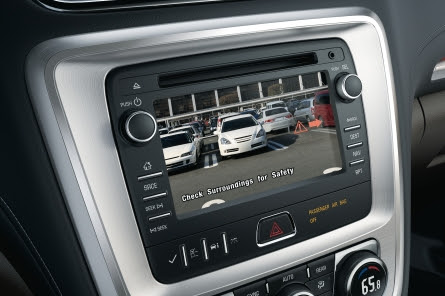
A possible requirement for automakers to put standard back-up cameras in all their new vehicles has been delayed again. This time, the deadline for the federal government to determine the requirements will be pushed back to 2015. According to Bloomberg, U.S. Transportation Secretary Ray LaHood sent a letter to Congress last Thursday informing members of this decision. Congress originally passed a law back in 2007 for the National Highway Traffic Safety Administration (NHTSA) to come up with requirements on how to increase rear visibility in vehicles. However, the final requirements have been delayed several times.
In the letter to Congress, Bloomberg says LaHood mentions that the cost for every life saved by having the back-up cameras could be as high as $18 million, and adds that they need to investigate the cost further before making a final decision on the requirement.
[Related: Lawmakers, Advocates Push to Make Back Up Cameras Standard]
In the meantime, The Detroit News says, “the National Highway Traffic Safety Administration plans to encourage automakers to add the cameras by proposing to disclose which cars have the cameras in the government’s New Car Assessment Program.” The distinction will be made by adding a “Recommended Advanced Technology Feature” label on those vehicles on a government website. While NHTSA says making rearview cameras mandatory is not cost-effective, the agency found that back over crashes result in up to 7,419 injuries per year. While most of the incidents are minor, there are still about 183 fatalities a year.
Although the deadline to finalize the rule has been pushed back until 2015, automakers likely won’t be required to install back-up cameras in all their new models for at least another 18 months after that. As of now, it looks like the rule, if finalized, won’t take effect until the 2017 model year.

Up to 1.56 Million Jeep Owners Will Get Free Trailer Hitches

2007 Jeep Liberty (Chrysler Group LLC)
Chrysler Group has agreed to honor the National Highway Traffic Safety Administration’s request to recall Jeep Grand Cherokee and Liberty SUVs, but only after NHTSA cut the number of affected Jeeps from 2.7 million to 1.56 million. The automaker says in a blog post that it “will conduct a voluntary safety recall of 1.56 million 1993-1998 Jeep Grand Cherokee and 2002-07 Jeep Liberty vehicles for supplemental improvement in low-speed crashes.” The fix? A trailer hitch assembly, which Chrysler says will “better manage crash forces in low-speed impacts.”
[RELATED: Chrysler Has Limited Time to Respond to NHTSA Recall Request]
Grand Cherokee and Liberty SUVs that already have trailer hitches will be inspected and the hitch will be replaced if necessary, but Chrysler says that Grand Cherokee and Liberty SUVs with factory-installed or Mopar-branded trailer hitches probably won’t need to be replaced.
Chrysler’s recall excludes about 1.1 million 1999-2004 Grand Cherokee SUVs, which were part of NHTSA’s original recall request. The automaker will perform a customer satisfaction action on these SUVs, inspecting and replacing aftermarket trailer hitches if necessary. However, owners without trailer hitches, as well as those with Mopar or factory-installed hitches, do not need to bring their SUVs in for inspection.
[RELATED: Chrysler Denies NHTSA’s Request to Recall 2.7 Million Jeep Vehicles]
USA Today reports that NHTSA says the Jeeps in question are prone to life-threatening fires after rear-end collisions, but Chrysler maintains that the vehicles in question are safe and defect-free. Additionally, USA Today says that Chrysler does not have to say the recalled SUVs are defective, which “will help Chrysler defend itself in any lawsuits over those Jeeps.”
CNNMoney reports, “Chrysler still faces liability risks in numerous wrongful death suits. NHTSA says there have been [at] least 37 accidents that caused fires and resulted in at least 51 deaths.”

Ford Upgrading MyFord Touch

Responding to customer complaints and sliding ratings in quality surveys, Ford is making changes to its MyFord Touch infotainment system, including adding buttons.
Infotainment controls in the 2014 Ford Fiesta (Ford Motor Company)
Autoblog writes, "The 2013 F-150 with MyFord Touch gives us a glimpse of what the new layout with buttons and knobs might look like, as Ford says a similar balance of touch screen capability and buttons/knobs are what's being planned for future models."
In a press release, Ford says that, combined, its SYNC and MyFord Touch systems are sold on 79 percent of 2013 Ford vehicles. It says that's double the rate of sales of infotainment systems on Honda and Toyota vehicles.
While sales of vehicles equipped with SYNC or MyFord Touch are strong, so are consumer reactions to the systems, which use voice commands, touch screens and capacitive controls. Automotive News reports that MyFord Touch "has hurt Ford's ratings in several quality surveys. Customers have complained the system is bulky, distracting and overly complicated to use. Ford has issued several software upgrades." Automotive News adds that in 2010, Ford was the highest-ranked non-luxury brand in J.D. Power & Associates’ annual Initial Quality Study. After MyFord Touch was launched, Ford dropped from a fifth-place overall ranking in 2010 to 23rd in 2011 and 32nd in 2012.

Chrysler Has Limited Time to Respond to NHTSA Recall Request

Chrysler Group LLC has just a few more days to formally respond to a request from the government's National Highway Traffic Safety Administration to recall 2.7 million Jeep Grand Cherokee and Jeep Liberty SUVs. On June 3, NHTSA asked Chrysler Group to voluntarily recall the vehicles. On June 4, Chrysler Group said it would not participate in a recall. NHTSA gave the automaker until June 18 to formally respond and explain why it would not comply with the recall request.
The 2007 Jeep Liberty. (Chrysler Group LLC)
The Detroit News reports that after Chrysler's response, the NHTSA "could then issue a formal finding and hold a public hearing seeking a recall. Chrysler last objected to a recall in 1997." The Detroit News adds that a public hearing could be a public relations disaster for Chrysler, as the hearing could include “possible testimony from parents who lost children in Jeep fires that the government blames on a defective design." According to the Detroit News, NHTSA says 32 rear-impact fires in 1993 – 2004 Grand Cherokees have caused 44 deaths. In the 2002 – 2007 Jeep Liberty, NHTSA says seven deaths are the result of five rear-impact fires.
It is exceedingly rare for an automaker to refuse to comply with a NHTSA recall request. Michigan Live writes, "Especially since Toyota Motor Corp.’s unintended acceleration problems in late-2000s, automakers have been open to recalling millions of vehicles nearly at the drop of a hat to avoid public scrutiny, lawsuits and collateral damage."
Cars.com says, "Automakers refusing to comply with a recall request are uncommon these days. But not uncommon in the past four decades are government investigations of similar fuel-system issues. One of the most well-known cases involved the recall of 1.5 million Ford Pintos and Mercury Bobcats in 1978 after rear crashes resulted in 27 deaths and two-dozen injuries."
Because the recall covers the composition and placement of the fuel tanks in the affected Jeep Grand Cherokee and Jeep Liberty models, fixing the issue on 2.7 million models would be very expensive for Chrysler Group. In a June 4 statement, the automaker says it "has been working and sharing data with the Agency on this issue since September 2010. The company does not agree with NHTSA’s conclusions and does not intend to recall the vehicles cited in the investigation. The subject vehicles are safe and are not defective."
Until Chrysler and the NHTSA resolve the issue, consumers are left in limbo.  Many analysts agree that whether Chrysler complies with the recall or not, owners of affected vehicles can expect to see a dip in their car's resale value.

AAA Study Shows Hands-Free Devices Are Not Distraction-Free


Study participant wearing EEG cap in test vehicle (AAA)
The American Automobile Association (AAA) and the University of Utah recently conducted a study on distracted driving. The study focused on the mental workload and reaction times for a driver performing various tasks not related to driving while behind the wheel.
The study concluded that “dangerous mental distractions exist even when drivers keep their hands on the wheel and their eyes on the road,” says AAA. User interfaces such as hands-free, voice-to-text systems may not require drivers to divert their eyes from the road, but they must still divert their attention from the task of driving. “The research found that as mental workload and distractions increase reaction time slows, brain function is compromised, drivers scan the road less and miss visual cues, potentially resulting in drivers not seeing items right in front of them including stop signs and pedestrians.”
At a press conference yesterday, AAA State Relations Director Justin McNaull said that “people are putting themselves in danger without necessarily realizing it.”
For the study, participants engaged in activities with increasing mental workload. These included baseline driving with no distractions as a control, listening to the radio, listening to a book on tape, talking with a passenger, talking on a hands-free mobile device, talking on a hand-held mobile device, interacting with a voice-to-text interface and solving basic math problems and memorizing words.
Participants performed each of these activities in three surroundings: sitting in front of a screen that showed a graphic known as a static fixation cross, using a driving simulator, and actually driving a vehicle down a city street. Throughout the experiment, participant brain wave activity was monitored using an electroencephalographic (EEG) skull cap.
Study participants also performed a detection response task (DRT) throughout the experiment. A small light mounted in their peripheral line-of-sight blinked either red or green. Participants were told to ignore the red light and tap the steering wheel with a finger when they saw the green light.
distracted driving
(AAA)
The results of the study show that as participants’ mental workloads increased, their reaction times slowed and the number of incorrect responses to the DRT increased. It also showed that as mental workloads increased, participants were searching for other dangers less often, meaning they developed a tunnel vision and were less aware of their surroundings. In the real world, this would equate to not noticing a red traffic light or not seeing a pedestrian crossing the street.
AAA Foundation for Traffic Safety President and CEO Peter Kissinger says that the results of the study “reinforce previous research that hands-free is not risk-free.”
One of the goals of this study, according to McNaull, is to increase public awareness to the notion that hands-free devices are still very distracting. Ideally, he said he’d like to see automakers and mobile electronics companies collaborate to create solutions that can be convenient but are also safer and less distracting.
Comprehensive in-vehicle infotaiment systems such as Ford’s SYNC system and Kia’s UVO system are becoming increasingly prevalent in new vehicles. USA Today reports that the number of infotainment systems equipped in vehicles is estimated to rise from 9 million this year to 62 million by 2018.

Apple iOS 7 Drives Car Technology into the Future


(Apple Inc.)
Technophiles get excited every time Apple holds a press conference. Yesterday’s announcement of the new iOS 7 operating system has people talking, mostly about the new look, iTunes Radio and the choice of either a man or woman Siri. In the automotive realm, people are talking about Apple’s iOS in the Car, which is a new feature of iOS 7.
Autoblog calls iOS in the Car “an auto-optimized version of the iPhone’s new operating system, iOS 7.” Basically, iOS in the Car will connect your iPhone or iPad with certain new vehicles’ infotainment systems, allowing you to control your Apple device through the car’s infotainment system rather than the device. iOS in the Car can give you turn-by-turn directions with the Maps app, as well as traffic updates and your estimated time of arrival. In addition, iOS in the Car can play iTunes Radio or your iTunes files through the car’s audio system. If you ask, Siri will return a missed call and play your voicemails for you, as well as read your texts and reply. iOS in the Car will also show incoming texts on your infotainment screen.
iOS in the Car maps
(Apple Inc.)
“It's basically Apple making a move to replace the built-in hardware and software that came with your car, and makes us wonder how automakers will react to all those iPhone users circumventing the OEM's own full-featured infotainment and navigation systems in favor of mirroring Apple's,” Autoblog writes.
Forbes reports that iOS in the Car will be available beginning in 2014 in select Nissan, Infiniti, Honda, Acura, Hyundai, Chevrolet, Kia, Volvo, Ferrari, Jaguar and Mercedes-Benz vehicles. Apple says iOS 7 will be available to download this fall for free for iPhone 4 and newer phones, iPad 2 and newer tablets, iPad mini and fifth-generation iPod touch devices.

General Motors Entices Car Shoppers with Free Maintenance Program


Photo Courtesy of General Motors
General Motors announced a free maintenance program for certain 2014 Chevrolet, Buick and GMC vehicles. Free routine maintenance will be covered for up to two years or 24,000 miles, whichever comes first.
Car shoppers who lease or buy a 2014 vehicle will be eligible for free oil and filter changes, tire rotation and a 27-point vehicle inspection at any Chevy, Buick or GMC dealership. General Motors explains, “Some alternative-fuel vehicles do not include oil changes, and some performance vehicles do not include tire rotations when that service is not recommended. The program covers up to four service visits in the 24-month period, and is fully transferrable to subsequent owners.”
GM Spokesman Jim Cain told The Detroit News that this program also covers 2014 vehicles that were purchased or leased in May, like the 2014 Chevrolet Impala. The Detroit News reports that GM will be launching 20 major refreshed or new models in 2013, and GM hopes this new program will help it retain customers.
Some of GM’s new vehicles for 2014 include the Chevrolet Corvette and Silverado, GMC Sierra and Buick LaCrosse.
Alec Gutierrez, senior market analyst at Kelley Blue Book, tells The Detroit News, “With the new maintenance program, GM now can sway buyers on the fence from a competitor that doesn’t offer a comparable program, and could attract additional buyers who are shopping based on price.”
Motor Trend says that Chevrolet, GMC and Buick aren’t the first non-luxury brands to offer free maintenance. Volkswagen and Toyota offers their own versions, as well. Volkswagen’s free maintenance program is for three years or 36,000 miles on 2009-2013 VW vehicles. Toyota’s program includes two years or 25,000 miles of maintenance.

Chrysler Denies NHTSA's Request to Recall 2.7 Million Jeep Vehicles


2002 Jeep Liberty/Photo courtesy of Getty Images
When the National Highway Traffic Safety Administration requests a recall, automakers usually comply. However, Chrysler Group is refusing NHTSA’s request for the automaker to recall 2.7 million 1993-04 Jeep Grand Cherokee and 2002-07 Jeep Liberty SUVs. USA Today writes, “NHTSA says the rear-mounted gas tanks in those vehicles are too vulnerable to leaking and catching fire in a rear-end crash.”
Chrysler says that the vehicles in question are safe, and that the automaker has been working with NHTSA to resolve this issue since 2010. “We believe NHTSA’s initial conclusions are based on an incomplete analysis of the underlying data, and we are committed to continue working with the Agency to resolve this disagreement,” Chrysler writes in a press release.
The Detroit Free Press reports that while most car companies honor NHTSA’s recall requests, “a federal judge could ultimately force Chrysler to comply or side with the automaker.”
"Chrysler must feel like it has a compelling reason to take such a bold stand,” says Michelle Krebs, senior analyst at Edmunds. “Since Toyota was publicly humiliated for dragging its feet on recalls just a few years ago, automakers have been quick to recall vehicles at NHTSA's request.” Edmunds reports that NHTSA noted 15 fatalities and 41 injuries supposedly caused by rear-end collisions in Jeep vehicles after extending its investigation last June.
NHTSA’s investigation was spurred by the Center for Auto Safety, which claims that the 1993-04 Grand Cherokee is four times more likely to catch fire in a crash than competing SUVs.
Chrysler says that the Grand Cherokee and Liberty “met and exceeded all applicable requirements of the Federal Motor Vehicle Safety Standards,” and that the risk of a fire in a rear-end collision is less than once for every million years of operation. The automaker claims that the risk is similar to the chance of crash-related fires in competing SUVs built around the same time.
Owners with questions or concerns can call Chrysler customer care at (800) 334-9200.

Auto Sales Strong in May

May sales numbers show a robust month of new car sales. While that's good news for car companies, new car transaction prices were also high, which means consumers are paying more for new cars.

The 2014 Cadillac ATS. Cadillac posted the largest sales gain in the industry for May. (Photo courtesy Cadillac)
According to data from Automotive News (subscription required), total automotive sales for May increased 8 percent compared with May 2012. So far in 2013, car sales are up 7 percent compared with the same period last year.
Cadillac and Porsche saw the biggest sales gains, with 40 and 38 percent increases compared with May of 2012, respectively. Cadillac says the sales gain are the brand's biggest increase since 1976 and makes the Cadillac the fastest growing automotive brand in the country. Infiniti, Mitsubishi and Mini posted the biggest sales decreases of mainstream brands. Infiniti sales were down 25 percent compared with May 2012. Mitsubishi sales were down 15 percent and Mini sales were down 3 percent.
Of American automakers, Ford (including Lincoln) had a 14 percent sales increase compared with May of 2012. Chrysler, including its Jeep, Dodge, and Ram brands posted an 11 percent sales increase. General Motors had a 3 percent increase compared with May 2012.
In a press release, Kelley Blue Book says that May new-car transaction prices rose along with car sales. Compared with April, KBB says that transaction prices are up 0.5 percent. That works out to consumers paying an average of $152 more on each new car.
As the increase in transaction prices show, strong car sales aren't always great news for consumers.  As demand increases, car companies don't need to discount their products. If you want the best deal on a new car, it may pay to wait until car sales slow down. If you can't wait, brands with weak sales are likely to have the best discounts. For example, Honda Motor Company sales, which include the Honda and Acura brands, only saw a five percent increase in sales compared with May 2012. KBB reports that their transaction prices in May were actually 0.4 percent lower than they were in April as dealers dropped prices to try to spur sales.

Hybrid and Electric Vehicle Owners Could Pay Additional Taxes


Photo Courtesy of Nissan
If you live in a state that charges gasoline tax and you drive an electric or hybrid vehicle, you may have to start paying extra fees. ABC News reports that North Carolina, along with some other states, is considering legislation that would charge fees to electric and hybrid car drivers. Many states depend on a gas tax to fund road maintenance. With more fuel-efficient cars and electric vehicles on the road, state governments who charge this tax aren’t receiving as much money and are looking at other fees to make up the shortfall.
In an editorial arguing against the new fees, USA Today says, “As of the beginning this year, state gas taxes ranged from a high of 50.6 cents a gallon in New York to a low of 8 cents in Alaska. Most states have plenty of room to bump up their taxes without resorting to more intrusive alternatives.”
North Carolina State Senator Bill Rabon, R-Brunswick, supports the annual fee proposal that would charge $100 for electric vehicle owners and $50 for hybrid vehicle owners. He tells Wilmington, North Carolina’s Star News, “We earn our revenue (for state) transportation from three sources: fees, highway use tax, or the 3 percent tax on automobile purchases, and the motor fuels tax, also known as gas tax.” He adds, “[The gas tax] is about 55 percent of our revenue.”
CNN writes that Washington state passed a bill in 2012 to charge electric car owners a $100 annual tax. Plug-in hybrids and any electric vehicle that isn’t able to travel over 35 mph are exempt from this tax.
USA Today says Virginia has already removed its previous 7.5 cent gas tax and replaced it with a wholesale fuel tax of 3.5%, an increase in state sales tax, a hotel tax and $64 annual surcharge on hybrid vehicles. USA Today adds, “The sales and hotel taxes force many people who don’t drive on Virginia roads to subsidize those who do. And the hybrid fee punishes people who act in the nation’s interest by purchasing more fuel-efficient vehicles.”
New Jersey is considering alternatives to their current gas tax. The proposed bill reads, “Every passenger vehicle registered and title in [New Jersey] shall be subject to a vehicle miles traveled fee in an amount equal to 0.83906 cents per mile.” The bill is supported by State Senator Jim Whelan, D-Atlantic City.
Automakers are trying to meet CAFE standards of 54.5 mpg for cars and light-duty trucks by 2025, so drivers can expect to see more state governments that have depended on gas tax propose new ways to get money for their transportation expenses. According to CNN, Arizona, Michigan, Oregon and Texas should be coming out with their own proposals soon.

QR Codes on Mercedes-Benz Vehicles Can Help Save Crash Victims


Photo Courtesy of Daimler AG
Daimler AG, the parent company of Mercedes-Benz, announced that it will be putting two QR codes on new Mercedes-Benz vehicles. The QR codes will be there to help emergency workers view rescue sheets, which show the best way to get occupants out of a crashed vehicle safely.
A QR code is commonly used so consumers can bring up a specific website on their smartphone or tablet without having to type in that web address. In this case, after taking a picture of the QR code on their mobile device using a QR reader app, first responders will be able to bring up the rescue map for that particular automobile.
Daimler says the rescue maps show major components of the vehicles, such as the battery, air bags and electric cables, so first responders can use the Jaws of Life and other tools properly. They add that having a QR code on the vehicle will make it faster to locate rescue information.
A QR code will be added to the fuel tank flap and on the B-pillar on the opposite side of all Mercedes-Benz vehicles. Daimler notes that “it seldom occurs that both these parts are badly damaged at the same time in an accident, and they are furthermore easily accessible from the outside.”

Are Mitsubishi and Volvo on the Way Out?


2013 Volvo S60/Photo courtesy of Volvo
A new report predicts that Mitsubishi and Volvo are among 10 brands that will disappear from the U.S. marketplace before 2014. “Car sales are growing in the United States, but brands with market shares under half a percent cannot compete with companies that either produce high-luxury models like Mercedes-Benz or multiline giants like General Motors,” says 24/7 Wall St.
The financial news site surmises that Mitsubishi and Volvo will stop selling vehicles in the U.S., much like Suzuki did last year. A number of factors go into the report’s predictions, which include declining sales, losses, rising costs that probably won’t be recovered through higher prices, and a declining market share.
The report notes that Volvo competes with higher-end offerings from companies like General Motors and Toyota, as well as entry-level models from Audi, BMW and Mercedes-Benz. 24/7 Wall St. writes, “With all that competition, consumer demand just is not there for Volvo cars.” Volvo’s sales are down 8 percent this year compared with the first four months of 2012. In contrast, Toyota sales are up 5.4 percent, while Audi and BMW sales have increased 14.2 and 5.7 percent, respectively.

2013 Mitsubishi Outlander Sport/Photo courtesy of Mitsubishi
Mitsubishi has also been in a sales slump compared with last year. The Japanese automaker’s sales are down 15 percent compared with the first four months of 2012, which is a larger decline than any other brand sold in the U.S. The report indicates that a small model lineup, as well as poor brand perception and lackluster performance in J.D. Power’s 2013 Vehicle Dependability Study aren’t helping Mitsubishi sales.
Some automotive journalists say that Mitsubishi and Volvo still have a fighting chance. Autoweek writes, “We'd say the jury is out on both automakers right now, but corporate parents Geely and Mitsubishi have deep pockets, so don't be surprised if these two are on the site's list of missed predictions in 2015.”

Automobile Magazine Releases 2013 All-Stars


The 2013 Chevrolet Camaro ZL1 is an Automobile Magazine All-Star. Photo Courtesy Chevrolet
Automobile Magazine released its 2013 All-Stars list today. The magazine calls the 11 cars on the list "the Best Cars in America."
According to Automobile, to be eligible for the All-Star honor, a car, SUV or truck must be on sale in America when the magazine does its fall testing. The current Automobile Car of the Year, the Tesla Model S, is ineligible for the All-Star list. Automobile also says it usually excludes exotic cars from the awards, which for 2013 were voted on by 16 Automobile Magazine editors and contributors. Forty-four models from 25 brands were tested for the All-Star list. The magazine didn't elaborate on what the criteria for judging is, beyond writing, "We bring no score sheets, just open minds and a desire to recognize the best and most significant vehicles."
Of the 11 All-Stars, four are sports cars. The Chevrolet Camaro ZL1, Porsche Boxster, Subaru BRZ and Scion FR-S all made the list, with Automobile writing, "This is the golden age of sports cars." The winners, it adds, "are part of a wave of high-performance sportsters that are coming from automakers in every country, as high performance has become an accepted approach to marketing and selling significant numbers of street cars."
For the more practical-minded, the Honda Accord, Ford Focus, Mazda CX-5 and Ram 1500 also made the All-Star list. The Audi A7 and BMW 3-Series make up the luxury names on the list, and the Volkswagen GTI balances utility with better performance than the typical small car.
Any time automotive awards are released, debate follows. However, many of the cars on this year's All-Star list are unlikely to generate much controversy. The Ford Focus, BMW 3-Series, Porsche Boxster, Volkswagen GTI, Honda Accord, Scion FR-S and Subaru BRZ are not only on Automobile Magazine's All-Star list, but were also named to Car and Driver's 2013 10Best list.

Our rankings take the awards a car wins into account. In addition to the Automobile All-Star list, the awards that impact our scoring include the North American Car and Truck of the Year, Automobile's Car of the Year, Car and Driver's 10Best, Motor Trend Car of the Year, Edmund's Editors Most Wanted, Consumer Guide Best Buy and Consumer Reports Recommendation. When a car wins one of these awards or is recommended by a publication, it gets a bump in its Critic's Rating score. Read more about how U.S. News ranks cars.